ChatGPT, Claude and Gemini: An Introduction to Choosing AI for Legal Work

Hello, I'm Noriaki Asato, Representative Attorney at LegalAgent.
If you simply want to try summarizing a contract, you can start with ChatGPT, Claude or Gemini. Once you begin handling company contracts regularly, however, the readability of the output alone is not enough to choose a service. The comparison needs to cover the subscription plan, the conditions governing the use of submitted information, and access permissions for internal materials.
Results obtained by a business team using personal accounts may differ from those obtained in the company's contracted environment, even under the same service name. The available models and features, connected materials, and administrator settings can all differ. For legal teams, I find it helpful to break the question of which AI is best into the work they actually want it to perform and the information that work requires.
Service Names and the Models You Use
ChatGPT is provided by OpenAI, Claude by Anthropic, and Gemini by Google. All three are generative AI services that can be used for tasks such as summarizing documents, drafting text, conducting research and organizing materials. The service name alone, however, does not determine which models are available, which files can be submitted, usage limits, or the scope of integrations with external services.
Even within the same service, available features vary by plan and administrator settings. A new model announcement does not necessarily mean that every user will receive access at the same time or on the same terms. Record the test date, plan, model name, and whether search or external integrations were used. A comparison based only on service names cannot later be reproduced under the same conditions.
In ChatGPT, users can attach files and ask about their contents, and consult internal information where supported connections and administrative settings permit. OpenAI's Company Knowledge documentation also explains that supported sources and permissions are required. How the service will access everyday contracts and internal policies is therefore a useful point of comparison when considering adoption.
With Claude, you can also consider document drafting using supplied materials and the use of business information through supported connectors. When working with a long contract, check the actual output to see whether it addresses the final clauses and appendices and whether proposed amendments conflict with defined terms. A reputation for handling long documents does not establish that a particular contract will be read accurately.
For Gemini, distinguish use through Google Workspace from use through a personal Google account. In companies that primarily work in Gmail and Google Docs, features available within existing work environments may be a reason to choose it. You still need to check separately whether the required features are included in your company's contract and whether administrators permit their use.
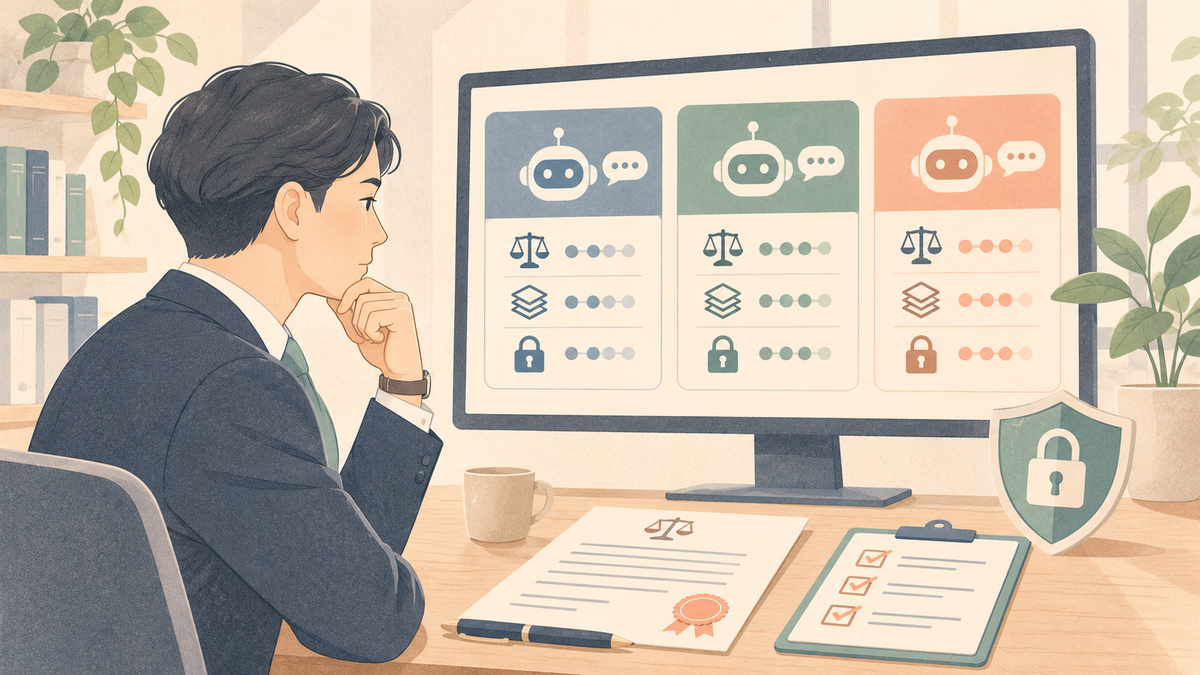
The capabilities of the three services overlap. Rather than relying on fixed rankings of strengths and weaknesses, I consider it more practical to test whether each can consult the relevant materials appropriately and produce the required deliverables in the environment your company uses.
Training, Retention and Sharing Conditions
The treatment of submitted information cannot be determined solely by whether a plan is free or paid. Paid personal plans and business plans may be subject to different conditions. Data being excluded from model training is also different from conversations and attachments not being retained.
OpenAI's enterprise privacy policy, checked on November 7, 2026, explains that inputs and outputs from offerings including ChatGPT Business, Enterprise and the API are not used for model training by default. Retention settings and administrative access within an organization need to be checked against the conditions of the particular service being used.
Anthropic's explanation of data use for commercial products likewise states that inputs and outputs from Claude for Work and the API are not used for training by default. It describes different treatment in circumstances such as a user submitting feedback. Read the conditions for feedback submissions as well as those for ordinary inputs.
Google's explanation of Google Workspace with Gemini states that data is not used for human review or to train generative AI models outside the domain without permission. Check whether that explanation applies to the accounts and features your company uses. It cannot simply be applied to the conditions governing consumer Gemini services.
For every service, the scope of review extends beyond the text entered into a prompt. It also includes attachments, conversation history, saved memories, information retrieved from external services, and the audience permitted to access shared links. If you add an external app or connector, check what information is passed to its provider and the provider's own terms.
For materials subject to a confidentiality agreement restricting permitted recipients or subcontractors, exclusion from training may not be enough to determine whether submission is allowed. Where personal information is involved, further examination may be needed depending on the purpose of use, the outsourcing relationship, the recipient, and the relationship with the individual concerned. Compliance with internal rules and commitments to counterparties needs to be checked separately from performance.
Comparative Testing with the Same Contract
Use materials that your company has approved for testing and that contain no confidential or personal information. Even if counterparty names are obscured, the history of a matter, amounts, or a combination of details may identify those involved. When using material from a real matter, review the entire document rather than assuming that masking names makes it suitable for submission.
Start with a single task to make the results easier to compare. For contract review, use the same requesting party's perspective and the same clauses. If individual memories or earlier conversations may influence the output, record those conditions too.
Review the following contract from the client's perspective.
Focus on the damages, subcontracting and termination provisions.
For each provision, separately identify the relevant clause number
and original text, its meaning, the client's concerns,
and any additional facts needed.
Do not supply facts that are absent from the materials; mark them unknown.
If you mention legislation or cases, provide sources you have verified
and state expressly where verification is incomplete.
Treat the response as a draft for human review.

[Contract text approved by the company for testing]
These instructions do not guarantee a correct answer. A person must compare the output with the original to verify clause numbers, quotations, definitions, exceptions and references to appendices. Even if a source URL is provided, someone needs to open it and check that the page exists and contains information supporting the answer.
Separating assessment into at least the following areas makes comparison easier.
| Assessment area | What a person should verify |
|---|---|
| Understanding the original | Accuracy of clause numbers, quotations, appendices and provisos |
| Identifying issues | Overlooked risks and whether facts absent from the materials were supplied |
| Quality of drafting | Necessity of amendments and consistency with definitions and other clauses |
| Workload | Time spent checking and correcting output and the number of follow-up questions |
A readable answer on one occasion is not the same as a reduced checking burden in everyday work. Testing several sets of materials and recording the errors and effort needed to correct them will also help define the scope of use after adoption.
Fit with Your Work and Review after Adoption
If much of the work involves finding internal materials, give greater weight to the search scope, access permissions and whether the answer lets you return to the original source. If contract amendments are the main task, focus on consistency between clauses, output formats and the process through which the responsible person checks proposed changes. Integration with existing collaboration tools can be convenient, but access settings need review if the scope of accessible materials becomes too broad.
Comparing monthly subscription prices alone can also obscure the actual cost. Consider the number of users, additional usage-based charges, the plans that include necessary administrative features, and the time staff spend checking and correcting output. What happens when usage limits are reached, and the regions in which desired features are available, also matter to continuity of everyday work.
At adoption, define what information may be submitted, which integrations are allowed, who checks the output, and who approves it before it is sent to a counterparty. If you use features that automatically send AI-generated drafts externally, define their permitted actions separately from draft creation. A person should verify the underlying sources and finalize legislative or case-law research results, contractual judgments, and responses to be communicated externally.
Changes to models, terms or administrative features can change the basis of your comparison. Reuse test materials for which the date and usage conditions were recorded, and check how the changes affect your company's work. Even after selecting a service, I consider it appropriate to review its permitted uses against verified performance and data-management conditions rather than fixing that scope indefinitely.
Services connected to this topic